Buuz and khuushuur without guilt: where the calories come from
Why does one buuz vary so much in calories? We break it down into dough, meat and oil, then share simple ways to enjoy your favourites without overdoing it.
 Aminasa
5 min read
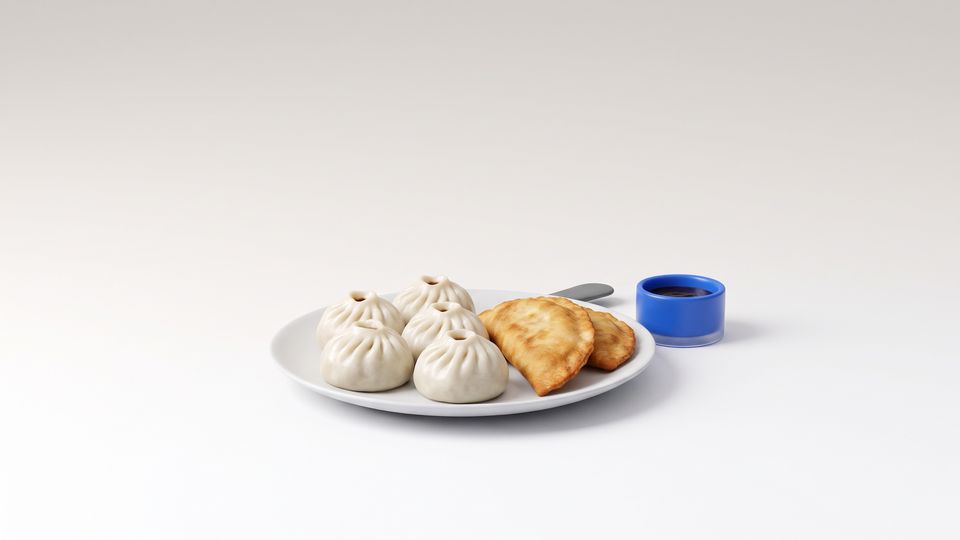
You sit down at a relative's table, a plate of steaming buuz arrives, and somewhere around your third one the host insists you have "just one more". Buuz and khuushuur are family food, holiday food and comfort food. Nobody needs to give them up.
Still, you probably suspect they are heavy on calories. Where exactly do those calories come from, and why does the number vary so much? Once you see the building blocks, eating a little less without missing out becomes much easier.
Where the calories come from
Food energy comes mainly from three sources. Protein and carbohydrate provide about 4 kcal per gram, while fat provides about 92. That is why fatty mutton adds far more energy than the same weight of lean meat.
A buuz has two main parts:
- The dough. White wheat flour has about 364 kcal per 100 g, most of it carbohydrate1.
- The filling. Using comparable foods in USDA FoodData Central, raw ground lamb has about 282 kcal and 23 g of fat per 100 g, while 95% lean ground beef has about 137 kcal and only 5 g of fat1.
Khuushuur adds a third ingredient: frying oil. As the pastry fries, it soaks up some of that oil. Vegetable oil has about 884 kcal per 100 g1, so even 5 g of absorbed oil adds roughly 44 kcal.
Why "one buuz" is not one number
There is no honest single answer to "how many calories are in a buuz?" Several things change the result:
- Size. A generous homemade buuz can easily be twice the size of a small canteen one.
- Meat-to-fat ratio. Adding tail fat or fatty rib meat pushes the calories up fast.
- Dough thickness. A thicker wrapper simply means more flour.
- The juice. Melted fat collects in the broth inside. If you drink it, you get those calories too.
The table below is a rough estimate, not a measurement. We took a medium buuz with about 20 g of dough (around 13 g of flour, assuming roughly two parts flour to one part water) and 25 g of meat, and worked out the energy from USDA data for comparable foods1.
| Component | Amount | Approx. energy |
|---|---|---|
| Dough | 13 g flour | 47 kcal |
| Fatty meat (about 20% fat) | 25 g | 64–71 kcal |
| Lean meat (about 5% fat) | 25 g | 34 kcal |
On these assumptions, a buuz made with fatty meat lands around 110–120 kcal and a lean one around 80 kcal. A large homemade buuz with plenty of fat can be well above that. Khuushuur are usually bigger and carry absorbed oil, so a single one can match two buuz or more.
Simple ways to keep portions in check
You don't have to skip buuz. Change how many you eat, what you eat them with and how fast.
- Decide your number first. Put your portion on a plate before you start instead of eating straight from the steamer, where it's easy to lose count.
- Choose leaner meat. At home, trim visible fat from the meat3 and mix cabbage, onion or potato into the filling.
- Add vegetables on the side. Fresh salad or pickled vegetables fill the plate and help you feel full. Pickles are salty, so keep that portion small; our salt and milk tea article explains why.
- Pick steamed or boiled over fried. WHO suggests steaming or boiling instead of frying3. Choosing buuz or bansh soup instead of khuushuur skips the frying oil altogether.
- Share. Split a big khuushuur with a friend and add a salad.
- Slow down. A review of 22 experiments found that people took in less energy when they ate slowly than when they ate fast5. Pause between bites and enjoy the conversation.
Vegetables and fat quality matter too
Most adults in Mongolia don't eat enough vegetables and fruit. In the 2019 national STEPS survey, 83.4% of adults ate fewer than five servings a day4. The World Health Organization (WHO) recommends at least 400 g of fruit and vegetables daily3. A handful of vegetables next to every plate of buuz is the easiest way to close that gap.
The type of fat matters as well. WHO advises keeping saturated fat below 10% of total energy and favouring unsaturated fats3. Animal fat is relatively high in saturated fat1, so leaner meat improves both the calorie count and the fat quality. If you fry khuushuur, use vegetable oil rather than animal fat.
Tsagaan Sar and Naadam tables
During Tsagaan Sar you may visit several homes in a day, with buuz waiting at each one. Set yourself a limit, say two or three per visit, and start with the salad. If the next home is close, walk there instead of driving.
At Naadam, khuushuur is part of the tradition. Enjoy one or two, and drink water or unsweetened tea rather than sugary drinks. One festive meal won't undo your health. What counts is your everyday pattern.
Tracking it with Aminasa
In Aminasa, take a photo of your meal and the AI identifies dishes such as buuz, khuushuur and tsuivan, then estimates the portion, calories, protein, carbs and fat (a Premium feature, with 3 free tries). You can adjust the portion or grams, remove anything it got wrong and save the meal. These are estimates, not lab values, but regular food logging is consistently linked with better weight-loss results6. For sharper estimates, see our photo logging tips.
Sources
- USDA — FoodData Central fdc.nal.usda.gov
- FAO — Food energy: methods of analysis and conversion factors, Chapter 3 (2003) fao.org
- WHO — Healthy diet fact sheet who.int
- WHO / Ministry of Health Mongolia — Mongolia Fourth National STEPS Survey 2019, Fact Sheet extranet.who.int
- Robinson E, Almiron-Roig E, Rutters F, et al. A systematic review and meta-analysis examining the effect of eating rate on energy intake and hunger. Am J Clin Nutr. 2014;100(1):123–151 doi.org
- Burke LE, Wang J, Sevick MA. Self-monitoring in weight loss: a systematic review of the literature. J Am Diet Assoc. 2011;111(1):92–102 doi.org
This article is not medical advice. It's general information and doesn't replace an examination, diagnosis or treatment by a doctor. If symptoms worry you, please see a healthcare professional.